Most government agencies have had some form of online payments for years. Residents can pay fees, fines, and renewals without coming into an office. From the outside, the system works.
But “working” and “working well” are different things. And the gap between them is usually invisible until it isn’t.
The agencies that discover this gap tend to find it the same way: a resident calls to ask if their payment went through. A staff member spends an afternoon reconciling transactions that don’t match. An auditor asks for records that exist in three different systems and none of them completely. These aren’t edge cases. They’re the natural result of payment systems that were built to collect money — not to connect to the work around them.
Here’s what a better approach looks like.
Keep Residents in One Continuous Experience
Most payment friction doesn’t start with the payment itself. It starts the moment a resident realizes they’re being sent somewhere else to complete it.
A redirect to an external portal — even a secure, functional one — creates a break in the experience. The branding changes. The context disappears. And for a resident who’s grown increasingly cautious about where they enter financial information online, that break raises an uncomfortable question: is this legitimate?
That moment of hesitation is often enough to cause abandonment. And when a resident abandons a government payment, they don’t leave — they call, they come in, or they submit the form again without realizing they already paid. The downstream cost of that friction falls entirely on staff.
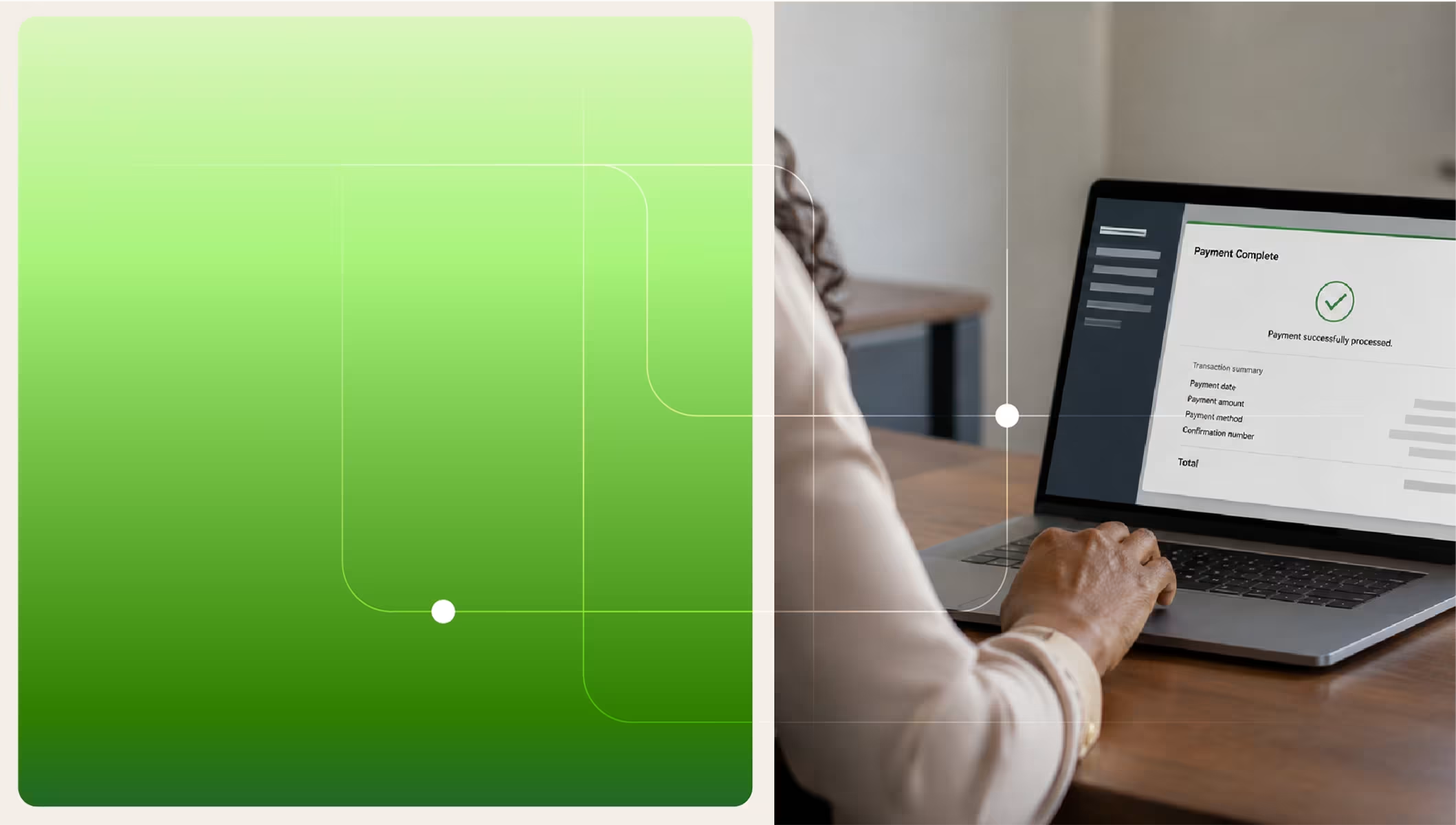
Keeping residents in a single, consistent flow eliminates that hesitation. They stay oriented, the process feels coherent, and the payment becomes a natural conclusion to something they’ve already started, not a detour.
Design the Payment Moment for Every Resident
Payment is the highest-stakes moment in any government service interaction. It’s where residents are asked to commit — to enter financial information, confirm an amount, and trust that it went through correctly.
That moment needs to work for everyone, not just residents who are comfortable navigating digital processes in English on a reliable internet connection without assistive technology.
For someone using a screen reader, unclear field labels or poorly structured forms can make it genuinely difficult to know what they’re being charged or whether the payment was successful. For a resident navigating in a non-native language, ambiguous confirmation messages create doubt at exactly the wrong time. For someone in a rural area with inconsistent connectivity, a multi-step payment flow that requires jumping between platforms is a transaction waiting to fail.
Designing for these residents isn’t a compliance exercise. It’s what determines whether a payment system actually works across the full population it’s meant to serve. That means clear, consistent labeling. Fees disclosed before the payment step, not during it. Confirmation that leaves no ambiguity about what was paid and what happens next. And error messages that tell residents what to do rather than just that something went wrong.
Treat Reconciliation as a System Design Problem
When payments and applications live in different systems, someone has to connect them. In most agencies, that someone is a staff member — searching for transactions, matching records, and resolving discrepancies before anything can move forward.
It doesn’t feel like a crisis. It feels like part of the job. But that’s exactly what makes it easy to miss.
The cumulative cost of manual reconciliation — in staff hours, processing delays, and audit preparation — is one of the most significant hidden expenses in government payment operations. And it scales with volume. The more transactions an agency processes, the more time gets absorbed by the work of connecting payments to the requests they belong to.
The agencies that solve this don’t do it by hiring more staff or building better spreadsheets. They do it by changing where the payment lives. When payment is embedded directly in the workflow, the connection between the payment and the application exists from the start. There’s nothing to reconcile after the fact because the record was never split in the first place.
Build the Audit Trail Into the Process
Audit readiness is where the true cost of disconnected payment systems tends to become most visible — usually at the worst possible time.
When payments, approvals, and records live in separate systems, reconstructing what happened requires pulling data from multiple places, cross-referencing timelines, and hoping nothing fell through the cracks. It’s the kind of work that takes days when it should take minutes, and introduces risk precisely because it depends on manual assembly rather than a single continuous record.
The agencies that handle audits most confidently aren’t the ones with the best audit preparation processes. They’re the ones that don’t need to prepare because the record has been building itself all along. Every payment tied to its originating request. Every action logged in sequence. Nothing to reconstruct because nothing was ever disconnected.
What These Practices Have in Common
Each of these practices points to the same underlying shift: treating payment as part of the service, not a separate step that happens to be attached to it.
When payment is disconnected — processed in a different system, managed by a different vendor, reconciled after the fact — the problems are predictable. Residents lose confidence. Staff absorb manual work. Audit trails get complicated. And the agency ends up managing the gap between systems rather than managing the service itself.
When payment is connected to the process it supports, those problems don’t require fixes. They don’t arise in the first place.
Evaluating how payments fit into your agency’s workflows? Connect with our team to see what a more connected payment experience looks like in practice.