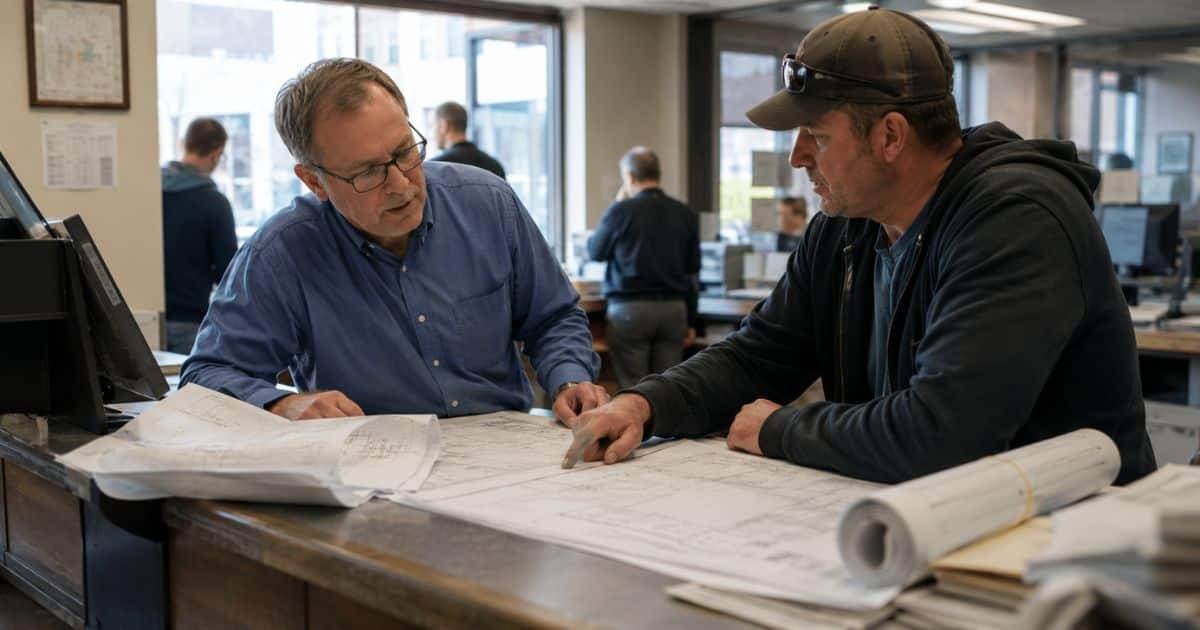
When an applicant submits a building permit application, the work doesn’t start and stop at intake. The form routes through zoning review, plan review, fire marshal approval, and final inspection. If the application is incomplete, it loops back for corrections. Once the permit is issued, the project moves into inspections. And for professional licenses, the cycle repeats annually at renewal. Permits and licensing are operational lifecycles, not software modules. The work begins when an applicant submits a form, continues through internal routing and approvals across multiple departments, loops back for corrections when applications are incomplete, and extends into renewal cycles that repeat annually.
Building Permits: Higher Volume, Local Jurisdiction
Building permits concern structure safety and code compliance. Zoning, structural, electrical, plumbing, fire codes: these are the regulatory checks a building department runs before issuing a permit. Building permits are issued by local city or county building departments, they are higher-volume transactions, and they are SimpliGov’s primary permits content focus. Environmental permits, by contrast, concern impact on air, water, land, or wildlife and are issued by the EPA, state environmental departments, or the Army Corps of Engineers. Environmental permits are more often state or federal and are frequently sequenced ahead of building permits. A developer may need an environmental clearance before a local building department will accept the application.
No Single “Typical” Process
There is no single typical permitting or renewal process. Every city, county, and state runs it differently. Professional licensing renewals (contractor licenses, business licenses) are typically annual cycles. Construction permits are project-specific. One jurisdiction may route a building permit through three departments. Another may require five. Renewal automation is a configurable capability rather than a standard behavior. The platform must adapt to the jurisdiction’s existing process, not force the jurisdiction to adopt a vendor’s predetermined workflow.
Integrating with Existing Permitting Software
Tyler Technologies is a named out-of-the-box integration. Agencies can orchestrate intake, routing, and renewal workflows around systems of record already in use. The permitting software stores what happened. SimpliGov runs the work that produces those records: the intake, the approvals, the handoffs between departments and systems. Legacy platforms store information. The coordination connecting them lives in email, spreadsheets, and manual handoffs. SimpliGov makes that coordination visible, structured, and repeatable. SimpliGov integrates with existing permitting software systems rather than replacing them.
Eliminating Incomplete Applications at Intake
Digital forms with validation rules ensure applicants cannot submit until all required fields and documents are provided. Staff stop spending time requesting missing information. Incomplete applications are eliminated at intake. The applicant gets instant feedback on what’s missing instead of waiting days for staff to respond. When the application reaches the reviewer’s desk, it’s complete and ready for processing. This is the front door of the lifecycle. Intake is where form builders stop and workflow platforms start.
Automated Routing and Status Updates
Automated routing sends applications to the right reviewers based on type and complexity. A residential deck addition routes to zoning and building review. A commercial development routes to zoning, building, fire, public works, and environmental review. Status notifications keep applicants informed without staff manually sending emails or answering phone calls. The applicant sees where the application stands in real time. Staff focus on reviewing applications instead of fielding status calls. This is the operational middle of the lifecycle: the work moving between desks, the approvals, the corrections loop when something is incomplete.
Renewals: The Cycle That Repeats
For professional licensing, the lifecycle doesn’t end at issuance. Contractor licenses, business licenses: these renew annually. The jurisdiction can configure SimpliGov to automate the renewal workflow. The system notifies the licensee 60 days before expiration. The licensee submits updated information. Payment processes automatically. The license renews without staff manually generating and mailing notices. This is the final stage of the lifecycle: the repeating cycle that extends the relationship between the jurisdiction and the applicant beyond the initial transaction.
Next Step
Map one permit type or licensing process from intake to issuance. Identify where applications stall, where staff manually request corrections, where routing happens in email. That’s the lifecycle you’ll automate first.
Ready to see it in action? Request a demo.